Tuesday, 20 August 2019

Extremely High Water Stress In 17 Countries, Representing One-Quarter Of The World's Population


Extremely High Water Stress In 17 Countries, Representing One-Quarter Of The World’s Population


August 20th, 2019
By Amelia Harris
Staff Writer for Wake Up World
It’s no secret that we are experiencing a world water crisis. But the situation may be more critical than we thought. A new list of 17 countries facing extremely high water stress offers insight into this issue.

17 Countries With Extremely High Water Stress

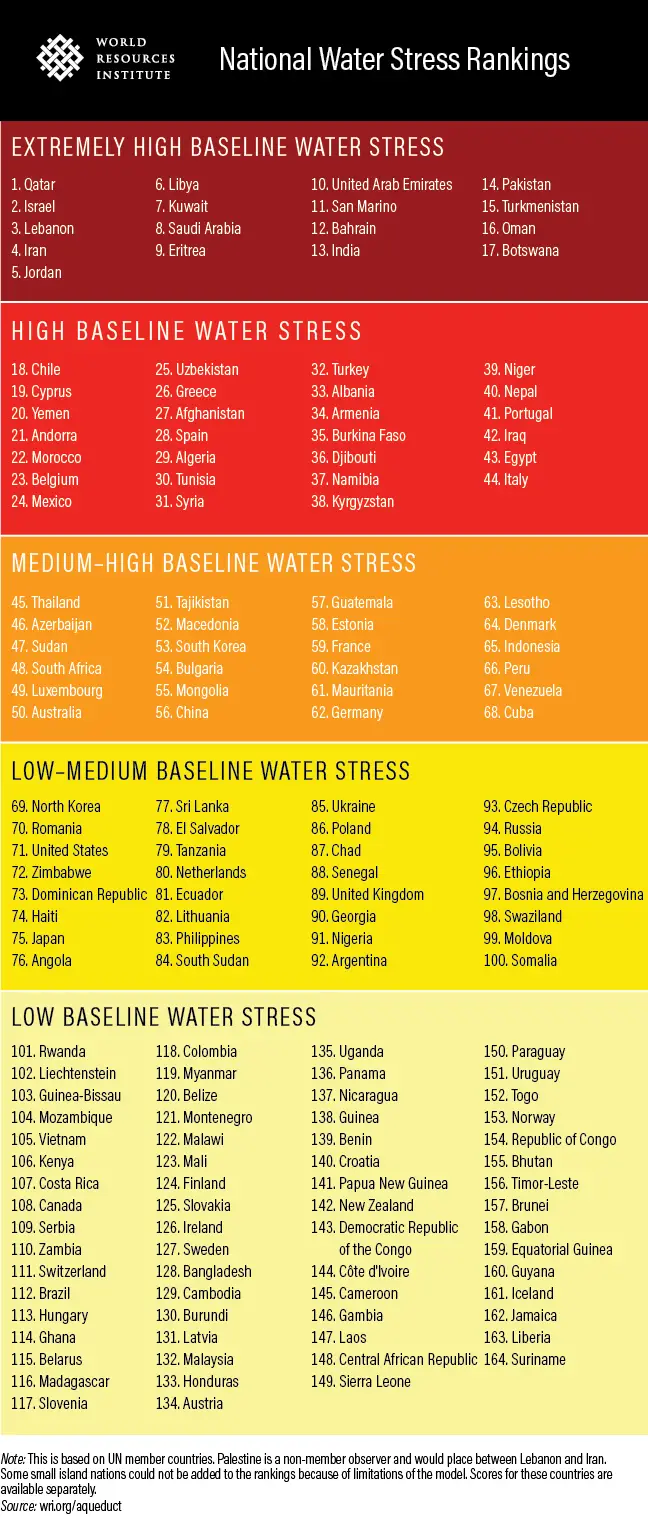
The World Resources Institute is a nonprofit organization whose goal is to help people live sustainably and protect the environment. The organization recently released a list of 17 countries facing extremely high water stress. These 17 countries represent 25% of the world’s population. (1, 2) In order of severity, they are:
  • Qatar
  • Lebanon
  • Israel
  • Iran
  • Jordan
  • Libya
  • Kuwait
  • Saudi Arabia
  • Eritrea
  • United Arab Emirates 
  • San Marino
  • Bahrain
  • India 
  • Pakistan
  • Oman
  • Turkmenistan
  • Botswana
For a country to be considered under extremely high water stress, it must be using 80% of its available surface and groundwater annually. These water sources are feeding municipalities, agriculture, and industry. (1)
If a country is using this much of its water, a negative change in availability can have dire consequences. And because of rising temperatures and population expansion, droughts and higher water withdrawals are projected to increase. (1)

The Impacts Of Water Scarcity

Water scarcity can have far-reaching consequences. Of the 17 countries identified with extremely high water stress, 12 are located in the Middle East and Northern Africa. Experts have identified that water stress can intensify conflicts and migration in these regions. And because water is used to grow crops as well as power industry, food insecurity and financial instability are other possible realities. (1)

Vanishing Groundwater

Places that have relied on groundwater for years are now finding that it’s running out. Mexico City is sinking because it’s using groundwater so quickly. Dhaka, Bangladesh has to draw water from aquifers that are hundreds of feet deep to supply its residents and many garment factories. (3, 4)
India, whose population is three times larger than all 16 of the other countries on the list combined, has widespread water issues. But the situation in Chennai, India’s sixth-largest city, is particularly challenging. The city has run out of groundwater, and the four reservoirs that provide Chennai with water have run dry. And to make matters worse, 2019’s late monsoon season means more time between the replenishing these reservoirs. (3, 4)
Water Stress In The United States

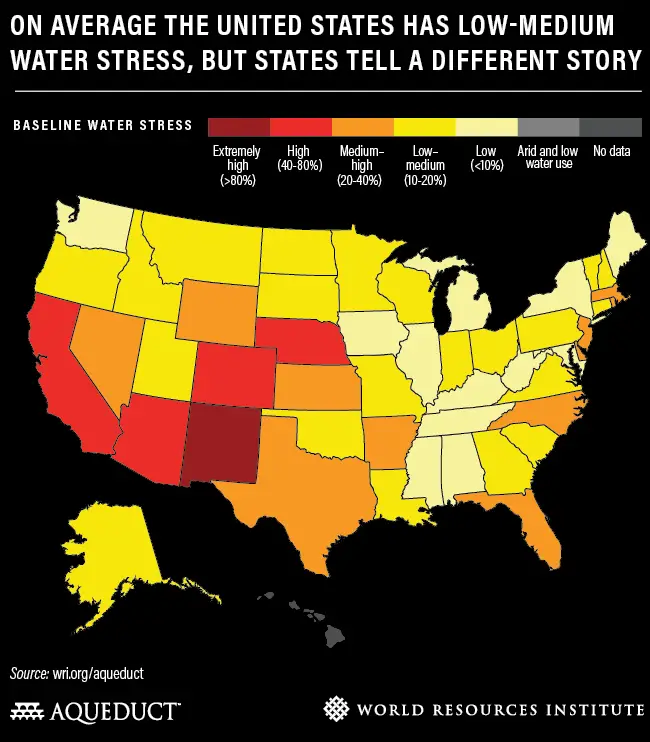
The World’s Resources Institute ranked the United States as having low-medium baseline water stress. But the U.S. is a large country with diverse ecosystems, and water scarcity varies from state to state and city to city. In particular, the Southwest, western Great Plains, and some of the Northwest have water supplies that can’t keep up with the demands of their citizens. (2, 5)
Much of the U.S. has experienced a drop in rainfall in recent years, leading to widespread drought. Water is a limited resource in places like California, where 66% of its agriculture faces extremely high water stress. Drought impacts two-thirds of Texas. And there are fears of a modern Dust Bowl in Colorado. (6)
It is hard to tell if these conditions will improve, as rainfall rates become more unpredictable in the coming years. And as average temperatures rise, soil dries out. So even if more rain does fall, it will remain challenging for farmers to water crops and feed their herds. (6)
Steps To Take For A Water-Secure Future

With a global water crisis looming, many are looking for small-scale actions they can take to be a part of the solution. On a cooperative scale, countries, states, and cities can evaluate their water usage. They should identify ways to decrease demand and invest in water efficiency systems. They can plan for droughts by collecting rainwater, refurbishing unused wells, and cleaning lakes and wetlands. Companies are also responsible for assessing and mitigating their water usage. (3, 6)
Additionally, individuals can take steps to conserve water in their homes and practices. These actions include:
  • Never leave faucets running unnecessarily (washing dishes, brushing teeth, shaving, etc.)
  • Take shorter showers – set a timer to get the hang of showering efficiently
  • Fix any leaks as soon as you discover them
  • Switch to low-flow toilets and shower heads 
  • Harvest rainwater for non-drinking functions, like watering the garden or irrigating your yard. (7)
  • Repurpose clean water from the sink or shower (waiting for the water to get hot) for plants
  • Grow or purchase foods that require less water to grow. For instance, millet needs far less water than rice. (3)
  • Buy clothing made from flax, linen, or monocel, which is a bamboo material that uses a reduced amount of water and toxic chemicals. Cotton takes an incredible amount of water to grow, so purchasing clothing that uses alternative fabrics is a great way to conserve water. (8)
As with any resource, consciously doing your part to conserve water where possible goes a long way. It may seem like a small contribution, but multiply that by 7.5 billion people, and the amount of water saved could make all the difference.
Article sources:
  1. https://www.wri.org/news/2019/08/release-updated-global-water-risk-atlas-reveals-top-water-stressed-countries-and-states
  2. https://www.wri.org/applications/aqueduct/country-rankings/
  3. https://www.nytimes.com/interactive/2019/08/06/climate/world-water-stress.html
  4. https://edition.cnn.com/2019/06/20/world/chennai-satellite-images-reservoirs-water-crisis-trnd/index.html
  5. https://www.globalchange.gov/browse/multimedia/water-stress-us
  6. https://www.wri.org/blog/2014/04/water-stress-magnifies-drought-s-negative-impacts-throughout-united-states
  7. https://www.conserve-energy-future.com/Advantages_Disadvantages_Rainwater_Harvesting.php
  8. https://goodonyou.eco/fashion-and-water-the-thirsty-industry/
About the author:
Amelia Harris is a writer and eco-activist, interested in health and all things esoteric, with a passion for sharing good news and inspiring stories. She is a staff writer for Wake Up World.

Saturday, 27 October 2018

The pain of a people and the shame of a nation:

Image may contain: one or more people, tree, sky and outdoor
One of the IDPs camps in Benue state, Nigeria, accommodating survivors of Fulani herdsmen attacks

Wednesday, 19 September 2018

Abacha Loot: Swiss lawyer tackles Malami over dubious N7bn legal fees

Enrico Monfrini, the Swiss lawyer hired by Nigeria to recover Abacha Loot, says Abubakar Malami, the attorney-general of the federation (AGF), is trying to change the facts on the $321 million recovered from Luxembourg.
TheCable had reported how Malami engaged Oladipo Okpeseyi and Temitope Adebayo, two Nigerian lawyers, for a fee of $17 million (about N7 billion) to do a job already completed by Monfrini.
In an interview with New Telegraph on August 26, Malami, questioning the services of Monfrini, alleged that the Jonathan administration agreed to pay Monfrini 20 to 30 percent as his fees before the final repatriation of the money to Nigeria— an idea the AGF said the Buhari administration frowns at.
“And he was indeed paid an amount which was not clear as to the concept and extent of what services he rendered whether this $321 million was part of his facilitation. But a point of interest is that as at the time this government came in the $321 million was not paid by the Swiss government,” Malami said in the interview.
Speaking with TheCable, however, Monfrini, a world renowned lawyer, said Malami has chosen to publicly make allegations and statements which tend to smear his reputation.
“I read the content of the article published by the New Telegraph on 26 August 2018 in which Mr. Malami is trying through lengthy statements to get people to believe different facts which are, to say the least, untrue,” he said.
Before President Muhammadu Buhari came into office, the Swiss lawyer said he had never heard of any professional fees “of 10 to 20 per cent” paid to lawyers.
“As far as I am concerned, my fees were always fixed at 5% or most of the time substantially lower. If one comes to the matter of the $ 321,000,000, I want to strongly stress the fact that this money was not what Mr. Malami calls ‘part of my facilitation’. It was money which had illegally been received by some members of the Abacha Family which I had started to search as of September 1999, found through researches operated by my firm and myself in Luxembourg in 2000, frozen in said country thanks to my intervention and finally forfeited thanks to my intervention in Switzerland in December 2014. I do not consider that all the enormous work invested by my firm and myself in this matter could possibly be quoted as a ‘facilitation’,” he said.

‘NO NEED TO PAY LAWYERS AGAIN’

Malami, in the interview, said Monfrini was considered to be among others for the recovery of the $321 million but he was asking for 20-30 percent as against the conventional five percent approved by the federal government. He said he had, however, convinced Buhari on a 10 to 15 percent pay for the Swiss lawyer but Monfrini rejected, insisting on 20 to 30 percent cut — which the president was not going to approve.
“It was against this background that a consortium of lawyers of Nigerian origin now submitted their proposals and we accepted their letters and they swung into action,” he said, adding that he had already proposed to the ministry of finance for the Nigerian lawyers to be paid a five percent cut from $321 million.
But Monfrini insisted he had already completed this job and his fees, in about 20 years recovering Abacha Loot, was around five percent.
“I sternly deny having ever asked Mr. Malami or any other public Officers of the Federal Republic of Nigeria to pay me anything more than the 5 % I was entitled to,” he told TheCable.
“I also have to repeat that the payment of my fees [happened] in December 2014 upon receipt by the Geneva Attorney General of $321,000,000 paid by the government of Luxembourg thanks to my intervention.
“It’s equivalently false to state, as Mr. Malami does, that at the time this government came in, the $321,000,000 was not paid by the Swiss Government as it was the subject of judicial pending before a court and to write that this situation was ‘the crux of the matter’ is so untrue that it becomes laughable.
“The truth is that the money was available to the government of Nigeria as early as December 2014 and as I said before, the matter for which Mr. Malami chose to appoint two new Nigerian lawyers for fees exceeding $ 17,000,000 [could have been done] in writing a letter to the Geneva Attorney General or to the government of Switzerland requesting the money to be paid back to Nigeria. Again, such an activity is not to be developed by lawyers but only through diplomatic consultations between States.”

DELAY TACTICS

In April, Monfrini had denied asking for additional fees when a syndicated article in Nigerian media sought to justify the duplication of his job by Malami.
Cable Newspaper Journalism Foundation (CNJF), a partner organisation with TheCable, for eight months, has continually written the AGF, seeking information and documents on the recovery of $321 million but the AGF is yet to respond.
CNJF has gone to court, seeking an order of mandamus compelling the AGF to make available the information and documents requested from its office pursuant to the freedom of information (FoI) act 2011.
TheCable had also asked the AGF what the newly engaged lawyers did to merit N7 billion.
The only time he responded to TheCable’s email enquiry, Malami said, “I am not ready to make any comments on my private email over the matter.”
The house of representatives has described the engagement of new lawyers for an already completed job as height of injustice. An ad-hoc committee was set up to look into the matter, but Malami resorted to delay tactics to frustrate the investigation.
Incidentally, Okpeseyi and Adebayo were lawyers to the Congress for Progressive Change (CPC), the legacy party of President Buhari, while Malami was legal adviser.
“Well, the truth of the matter is a relationship between the lawyers and I exist. There is no doubt about that,” Malami disclosed in the interview with New Telegraph."
https://www.thecable.ng/.W59m4Q31sDY.facebook

Thursday, 8 February 2018

The unreported massacres of Tiv people and govt conspiracy in Nasarawa state, Nigeria:

"THE CONTINUOUS HUNTING AND KILLING OF INDIGENOUS TIV PEOPLE
OF NASARAWA STATE AND THE SAFE HAVEN OF THE TERRORISTS DISCOVERED IN WAMBA LGA February 3rd 2018
By Mohammed Otuwose
When people lost loved ones, naturally,
they feel hurt. More so when precious lives are snuffed out for no just cause by dagger-wielding and trigger-happy terrorists. The desire for vengeance, at this point, is often rife amongst folks so offended.
However, one evil, no matter how gruesome, doesn't justify another. When killer-herdsmen butchered people in parts of Tiv-land, men and women of goodwill across the world cringed with trepidation. The vile act was universally condemned. Rightly so. Same way the killing and burning of Fulani travellers in Gboko (Tiv-land) was condemned by all and sundry who still uphold justice and the sanctity of human life.
It's wrong and absolutely in bad faith to look at all itinerant Fulani and Tiv people with disdain and to hurt them for nothing. Most Tivs are so genuine and mundane that they just want to live their simple rustic lives with little or no knowledge of why there's so much hatred, enmity, crisis, killing and death in society.
There are still ongoing killings of local and indigenous Tiv people in the rural and farming forests in Awe, Keana LGAs with the spread and escalation to ATABULA community and Idevi community all in Jenkwe Development Area of Obi LGA. That, four days ago,15 tivs were killed and only yesterday another 7 killed, and 11 injured. It is certain Fulani-herdsmen with the covert support of the Nasarawa State Government but usually rush to the scene and in front of the TV camera and media to mislead the world.
The unfortunate thing is that the print media are not reporting this to the public and investigating journalism is lacking by mainstream media due to inaccessibility and fear of their lives.
The indigenous Tiv people of Nasarawa State killed by the Fulani herdsmen terrorists in Nasarawa State are in thousands and unaccounted for especially in inaccessible farming forest and this is still ongoing with the security agencies helpless and can't access these places.
Our investigation also revealed other ethnic groups living with Tiv people in these places are fearing for their lives with most often times Fulani herdsmen searching for tivs from Household to household, so fear of unknown grip them too and are handicap to report to the government which they believed are the one supporting the Fulani herdsmen terrorists. Our undercover reporter shockingly traced and discovered training and safe haven camps in the forest of Wamba LGA of Nasarawa State. These safe haven camps are used by the herdsmen terrorists and foreign mercenaries brought to launch attacks in Southern Kaduna, Plateau, Nasarawa, Taraba, and Benue States. After which they withdraw and return to safe haven for rest and to escape being caught. The reporter also confirmed knowledge of the existence of the save haven for the terrorists among few locals in the forest but claimed the reported this to their chief (Oririndere).
We are calling on the Federal Government to investigate and conduct security surveillance in these LGAs(Awe, Keana, Obi, Doma, Nasarawa and Wamba) and deploy military to clear the terrorists in the places stated."

Wednesday, 10 January 2018

Mindless Nigerian Fulani terrorists on the prowl in Benue, Nasarawa and Taraba state.

Besides the pogrom, they burn food stores and move to the farms to destroy harvested crops:

Heaps of yams burnt by Fulani "herdsmen" in the ongoing attacks on Tiv villagers in Taraba state.
Tiv of Benue, Nasarawa and Taraba are presently the target of the killers.
... After solving the "Tiv question", they will, as usual, face other ethnic groups that do not submit to their whims and caprices.
Nigeria has moved many steps backward under president Buhari.

Sunday, 19 November 2017

Fulani cattle owners and their herdsmen grow in confidence as they, again, reject the states' Anti Open Grazing laws:

Hear them: "So they should give us land so that we can practice our occupation.” He said contrary to beliefs in some quarters land trespass has been the source of Fulani and farmers crisis in Benue, it was rather cattle rustling, youth unemployment and what he called rural banditry, wondering why there was (no) pending cases of land trespass in any law court in the state. “I challenge the Benue State Government to tell us how many court cases that have to do with trespass on land are before the courts in Benue? Or is it that they don’t have faith in the judiciary that they don’t take cases there? “So, it’s not a question of trespass on land, that’s just the truth. I want people to understand that these conflicts we are having year in and year out, the major drivers are not on trespass on land. Rather, the drivers are cattle rustling, rural banditory, youth unemployment and desperate politicians that want to create crisis so they can sustain themselves in power, “he added."
FULL TEXT BELOW:
- Why Nigerian Fulani won’t accept ranching — Miyetti-Allah
(By Joseph Erunke ABUJA)
THE Fulani in Nigeria have said they will not accept cattle ranching because the country’s geographical location was not suitable for it. Besides, the Fulani said the species of cows they had, as subsistence livestock farmers, were not good for ranching in the country, saying they could only be confined to ranching if their livestock were replaced with breeds suitable for it. This was even as they said the anti-open grazing laws being established by state governments would die a natural death like ‘political sharia law’ in Zamfara. According to them, the laws are being used as campaigns by some people to win votes in 2019 elections. Addressing newsmen, yesterday, in Abuja, through their socio-cultural association under the aegis of Miyetti-Allah Kautal Hore, the Fulani insisted that events in history showed that ranching was not practicable in Nigeria and to this end, urged the Federal Government to immediately stop state governments from enacting anti-open grazing laws. National Secretary of Miyetti-Allah Kautal Hore, Saleh Alhassan, who read the association’s prepared speech to newsmen at the event, called on the Federal Government to stop state governments, especially Benue and Taraba states, from going ahead with implementing the laws. He said: “The whole experiment of ranching in Nigeria is a total failure, you can google it, it’s there on the Internet for everyone to see. “ Right from the 70s,the old Gongola State had experimented ranching, the same with Kaduna State and even the old Plateau State. All the ranches collapsed because the geographical location of this country is not suitable for ranching. “In places where there are successful ranching in the world, the volume of rain per annum in those areas is at least four to seven months, that’s why you have grasses that can naturally be sustained. “At the same time, you must have the necessary breeds that will support even ranching. The current breeds we have in this country cannot be supported by ranching. “Anywhere you keep these volume of cows we have now, for two weeks, they will eat out everything and you will have ecological disaster, “he said. Alhassan said the purpose of the briefing, coming barely a week after the previous one, was to further reassert the position of the Fulani on the anti-grazing laws enacted by state governors and their opposition to it. He said: “ We view the anti-grazing law as an agenda to destroy our means of livelihood by visionless and desperate politicians. “Anti-grazing laws are nothing but populist agenda designed by visionless and desperate politicians to destroy our means of livelihood. “This dangerous gambit must be nib in the bud by the federal government through the security agencies as it portends great danger to the cooperate existence of the country. “These laws are oppressive and negative and are fundamentally against our culture as Fulani pastoralists, against our economic interest and against the constitution of the Federal Republic of Nigeria. “ It is important to note that inter-state movement of pastoralists is similar to inter-state commerce and it is only the National Assembly that can legislate on that aspect as captured in item 62 of the exclusive legislative list. So no state governor can decide to stop movement of pastoralists because that is their own form of commerce. So, they have gone against the constitution. “The laws do not take into cognisance our sociology, our economic interest, our production patterns, climate variations and factors that pushed pastoralists into these migrations. These migrations are not picnics, they are detected by ecological needs. “It is a common knowledge that the primitive form of agriculture practiced in Benue and Taraba states and indeed all over the country, is not consonant with global best practices. “ So why singling out the pastoralists and insist that they must ranch which is the global best practice? That’s out argument. “If the whole agricultural policy, the whole development of agriculture in Nigeria is still at this primitive stage, you cannot single out the herders who are also farmers that they must practice global best practice, it’s not possible.” Alhassan insisted that Benue State government breached the constitution by stopping open grazing, given that the River Benue Basin, its tributaries and lakes were under the control of the federal government. “Again, very fundamentally,the River Benue and the tributaries and also the international routes and roads that pass through Benue don’t belong to Benue State Government, they belong to the Federal Government. Benue State Government has no jurisdiction over River Benue, its tributaries, the lakes, the river basins, they are all federal government’s. So how do you now start to legislate to say ‘you are going to stop access to those natural resources?’ “Between January and and early May,is when pastoralists move to the river basins because that is the peak of dry season and most of the rivers pastoralists use to water their animals dried up and they now move towards the River Benue. “So designing a policy that will exclude the herders completely is wrong, what they should have done is to have restricted areas for the herders and then give them access to grazing corridors and watering points during those peak periods of dry season. “As cultivation comes up during the rainy season, these people naturally migrate northwest. So, it’s detected by climatic changes. That’s why we are saying it’s not possible, the law will not work because it’s not well thought out. “Then for you to create a ranch, the environmental impact assessment must be done on the areas earmarked for the ranch, and it must not take a minimum of two to three seasons. That’s to say you must do studies during the wet season, do studies during the dry season and then repeat it so that you compare before you can say this place is suitable for a ranch. “So ranch is technologically driven, it’s capital intensive and it’s not practicable for this kind of subsistence farmers we have, the livestock farmers are subsistence farmers. It’s just like saying nobody will cultivate his land if he doesn’t own a tractor, so how many people will go to farm? “ So, it’s not that we don’t want to respect law and order but when you make an impossible laws, then you are not creating peace. You are either deliberately attempting to provoke conflict for either political reasons or you are being hoodwinked and deceived by desperate political advisers just probably because they want to get money out of you, they make you create laws that will create conflict.” The Miyetti-Allah Kautal Hore scribe continued:”In particular, the Benue Valley which has been causing problem in land resources, we have issue of population and nature and pattern of settlement. It’s not just the herders that can be blamed for it. “If you look at it typically, the Tiv people have the culture of nomadic farming, if they farm this year here, the next year they move to another location and their culture of reproduction is such a manner that it has made useless of land tenure system. “ There’s no Tiv farmer that will tell you that ‘we have a family land’ because of the fragmentation of the land, because of the number of children they have, they cannot inherit any parcel of land. So they now straddle along communities in the Benue Valley and neigbouring states’ lands belonging to other communities and fallow lands that pastoralists use for grazing, they will cultivate them in a very extensive primitive manner, occupying large hectares of land. “If they cultivate here this year, the next year, they move to other places. That is why they have problem in Nasarawa border communities, they have problem in Taraba border communities. All those areas are extensively being cultivated, there is no mechanization any where, and there’s no modern farming. So, with the pressure on the land resource, if you want to address it, you cannot just single out the herders and say ‘they must be kept in one place without making any provisions for them.’” According to him, the anti-open grazing laws were being targeted at Fulanis and their livestock. “And these laws, if you look at them, they are targeted at the pastoralists because one, you have not provided any space for them and you ask them to go and buy land to create ranches when the context of the law you created, you have already poisoned the minds of the people that own the land, that you are creating this law because of the crisis that is in place. So who will allow anybody to have access to the land? “So our point is that if the government is serious, they should make land available to us after all, the Land Use Act vests lands in the hands of state governors. So they should give us land so that we can practice our occupation.” He said contrary to beliefs in some quarters land trespass has been the source of Fulani and farmers crisis in Benue, it was rather cattle rustling, youth unemployment and what he called rural banditory, wondering why there was pending cases of land trespass in any law court in the state. “I challenge the Benue State Government to tell us how many court cases that have to do with trespass on land are before the courts in Benue? Or is it that they don’t have faith in the judiciary that they don’t take cases there? “So, it’s not a question of trespass on land, that’s just the truth. I want people to understand that these conflicts we are having year in and year out, the major drivers are not on trespass on land. Rather, the drivers are cattle rustling, rural banditory, youth unemployment and desperate politicians that want to create crisis so they can sustain themselves in power, “he added."

Read more at:
 https://www.vanguardngr.com/2017/11/nigerian-fulani-wont-accept-ranching-miyetti-allah/

Tuesday, 17 October 2017

Uniform men lured us to be killed by herdsmen – Plateau attack survivor

"No fewer than 29 persons, mainly women and children, were, yesterday, killed in an attack by suspected herdsmen in Nkiedonwhro village of Irigwe chiefdom in Bassa Local Government Area of Plateau State. Three others sustained various degrees of injuries. It will be recalled that several attacks had been carried out by herdsmen in villages, forcing Governor Simon Lalong to declare a dusk-to-dawn curfew in the local government area. However, despite the curfew declared last Friday, night attacks have persisted in the villages with many residents already fleeing the troubled area. The President’s position Meanwhile, President Muhammadu Buhari has directed the military and the Police to put mechanism in place to ensure that there is no reprisal attacks in Plateau State. President Buhari, who was reacting to the killing of about 29 persons by herdsmen, said the madness should not be allowed to continue. In a statement by the Senior Special Assistant to the President on Media and Publicity, Garba Shehu, the President said he received, with deep sadness and regret, news of the killings of over 20 persons. According to the statement, “President Buhari believes that this madness has gone too far. He has instructed the military and the Police to not only bring the violence to an instant end, but to draw up a plan to ensure that there are no further attacks and reprisal attacks by one group against the other. “President Buhari is devoted to the sanctity of Nigeria’s unity, and he encourages Nigerians of all groups to learn to live together in peace and harmony. “He commiserates with the governor and people of Plateau State, and with those who lost their loved ones, friends and family: may God comfort them as only He can.” Army, Police keep mum Spokesman of Operation Safe Haven, Captain Adam Umar, did not answer calls from his mobile phones, while his Police Command counterpart, Matthias Tyopev, said he was awaiting the report from the Divisional Police Officer of Bassa Local Government Area before talking on the issue. However, President of Irigwe Development Association, Sunday Abdu, who confirmed the incident, claimed that the victims were taken to a classroom in a public primary school in the village by members of Operation Safe Haven, saddled with the responsibility of keeping peace in the area, only to be abandoned. According to him, “what happened was annihilation; innocent people killed that way in cold-blood; they just wiped them out. “The security men ushered the people into a classroom before the attack in the village. They later ran away and left the victims to be massacred by the assailants. The mass burial is about taking place. “How can you have personnel of the Federal Republic of Nigeria run away and leave the citizens? How and why? That is to tell you that we don’t have security, it is a simple as that. “Twenty-seven people have been confirmed killed, but someone told us that two more bodies have been discovered. I have not confirmed that yet. Series of attacks “Since the gruesome attack on Ncha village on September 7, there has been series of other attacks. Like Hukke, in September 9, two persons were killed; Nkyie Dongwro, October 8, one person killed, another wounded; Kpachudu, October 10, a young man killed by a Mobile Policeman. “Nzhweruvo and Tafigana, October 11, three dead and houses razed; Rikwe Chongu, October 12, houses razed; Taegbe, October 14, six dead, five injured and houses razed; Nkyie Doghwro, October 16, 29 dead, three injured at a school used as camp and protected by security. “It is painful that these happened despite useful timely information provided to security personnel regarding movement and mode of operation of the assailants. “While no single attacker has been arrested by the security agents, they rather arrest and detain helpless natives on suspicion of possessing weapons, despite handset being found on the ground during the attack. “We urge the government, if it must sustain the curfew, to do the needful and stop these nightly attacks on our people; our people cannot go to their farms anymore, even as harvest is near for fear of attacks by herdsmen, who openly graze on ripe crops.” Rep begs FG to intervene Meanwhile, member representing Jos North/Bassa Federal constituency, Suleiman Kwande, called on the Federal Government to investigate the renewed violence in state, especially in the Irigwe Chiefdom. In a statement Kwande said: “The native of the locality in the last few weeks have suffered unprovoked attacks. I call on the Federal Government to set up a committee to investigate the fresh killing of innocent persons, including children, women, men and the aged in a primary school, where they were taking refuge. “Security agencies must wake up to their constitutional responsibility of protecting lives in the state; this evil must be stopped — enough of all the killings.”
SURVIVOR SPEAKS:
Meanwhile, a survivor, Samson Amos, who narrowly escaped death during the attack, told Vanguard: “It happened at about 8p.m. This attack is the second in the village. When they attacked us the first time, the military was stationed here to avoid a repeat. “When we got wind of a likely attack yesterday evening (Sunday), we reported to the military and they told us to come and stay in a classroom that has been provided for them as operational base. “We obediently went into the classroom to sleep. But some people were skeptical about this, so they left. “Not long after we entered the classroom, the military left and not long after, the attackers came and we were trapped. They unleashed mayhem. “I counted 27 corpses, two more who were in the hospital died and three others are still in the hospital being treated for various degrees of injuries. A mass grave has been dug to bury the people.” Asked about the identity of the attackers, he said: “You know we have co-habited with the herdsmen for a long time. It is easy to recognise them. We saw them and we know they are the ones killing our people. This is an incident which keeps recurring and there is room for a repeat. “The protest that was held at Jebbu Miango last week was against the seeming lacklustre attitude of the military. The people don’t have faith in the military anymore."
Read more at:
No fewer than 29 persons, mainly women and children, were, yesterday, killed in an attack by suspected herdsmen in Nkiedonwhro village of Irigwe chiefdom in Bassa…
vanguardngr.com