Friday, 28 August 2015

Boko Haram' s "fame" overshadows Fulani cattle herders' atrocities:

Fulani militia captures 16 Kaduna villages, displaces 10,000

 
By Luka Binniyat
MANCHOK—The Atakad Community Development Association, ACDA, yesterday, said Fulani militia have captured 16 Atakad villages and killed no fewer than 180 persons, with 10,000 forced to become refugees since the violence started in 2013.
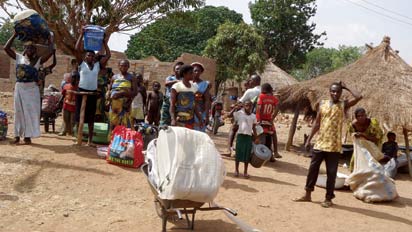
*Some displaced persons moving to new locations
Speaking at Manchok, Kaura Local Government Area, Kaduna State, during the burial ceremony of the assassinated District Head of Zangang in Atakad Chiefdom, near Manchok, Mr. Yohanna Shinkut, the National President, ACDA, Mr. Ishaya Kunden, said the world was not interested in their plight, even when, according to him, they formed part of the most traumatized of human society.
Shinkut was said to have been ambushed and shot dead in his car near his Zangan home around 8p.m., last Saturday, by suspected Fulani gunmen.
Most of Atakad land is located on the lush green hills and valleys of the lengthy Kagoro range of the highland in Kaura council of Kaduna State. It is about 250km South of Kaduna metropolis.
Kuden said: “Since these invasions and killings of our people started on March 23, 2013, we have lost 16 villages to Fulani invaders. At the last count, 180 people have been killed.

Taken over
“Right now, Fulani men are fully settled with their cattle and families, in Mayit, Agwom, Zakai Gira, Tunga Magwot, Telak, Zakum and Kirim. Go there and see them. Their cattle are grazing on everything we left behind.
“The world has forgotten about us, as if we are not human beings and as if are we not part of the most injured in human society. 10,000 Atakad natives are now homeless and are wondering from relations to churches and anywhere else they can get assistance.
“The state government has done very little to help. Only the Churches and some non-governmental organizations are coming in with relief materials for victims still hanging around.
“All our children are out of school. Men cannot go back to their farms. It is horrible. All we are asking is for more soldiers and a few things to defend ourselves. We can return if we get that assistance.”
The overall Chief of Atakad Chiefdom, Chief Tobias Wada, in his remarks at the Baptist Church Manchok, venue of the burial service, said: “The people of Southern Kaduna must be united to fight this dangerous trend.

‘Their goal’
“They want to take over our hills and use it as a launch pad to invade Southern Kaduna. That is why they are killing our people in Sanga and chasing them from the hills.
“Southern Kaduna people and those governing us cannot afford to see these series of murder of innocent keep on repeating itself.
“I call on our brothers in Ganawuri, who are accommodating the Fulani in their lands, to see reasons to negotiate with us and the Fulani.”
The burial was attended by prominent traditional rulers from Southern Kaduna, the clergy and a broad segment of Atakad and Maroa communities amidst heavy security mounted by the Nigeria police and the military.

Foiled attack
A security source said there was an attempt, Monday night, by Fulani militia to dislodge the military stationed on the border between Plateau and Kaduna states, from where the invaders usually sneaked into Kaduna State.
The source said: “There was exchange of gunfire between our men and some marauders from Ganawuri, Plateaus State border that lasted till this morning.
“We repelled them, and there was no casualty from any side. Had they succeeded, this burial ceremony may not have held.”
 
- See more at: http://www.vanguardngr.com/2015/01/fulani-militia-captures-16-kaduna-villages-displaces-10000/#sthash.p5k2C0zC.dpuf

Fulani Cattle Owners/Herders Must Evolve to The Ranch System::

Their decades-old murderous activities have always been downplayed through manipulative tactics from their strong and rich Associations (Miyeti Allah Cattle Breeders Association of Nigeria, among others) which membership is made up of prominent Nigerians of Fulani descent who make no pretext of their loyalty and commitment to promoting the interests of their kinsmen at all costs and by all means. Since 2001, there have been spates of killings linked directly or indirectly to Fulani cattle herders in Nigeria whose resolve to turn the still greener parts of Nigeria, particularly central Nigeria, into "Grazing Reserves & Routes" has not mellowed down despite the prevailing realities of population increase with its attendant demands on land. It is curious that the fuanis have silently rejected the Ranch System which is more secure and productive in comparison to the open and unbridled grazing of cattle which is largely responsible for the accelerating desertification in the core northern part of the country.

The Number of deaths in what is today known in Nigeria as "herdsmen attacks" is in thousands, with millions displaced from their ancestral homes and properties in billions of naira value destroyed. So, when Senator Bruce Murray spoke the truth of what those of us in the affected areas knew already, we could only heave a little sigh of relief that at last prominent Nigerians outside the areas now under "Fulani herdsmen" occupation are beginning to see through the veil of lies that have been bandied and sold out to the Nigerian public by the Fulani cattle unions and their influential financers to hoodwink the vast majority to the crime against humanity being committed by armed Fulani herders and their mercenaries against indigenous sedentary farmers of the area, which the residents call the "Middle Belt" of Nigeria.

Below is Senator Murray's statement:

"It will shock Nigerians to know that more people have died as a result of Fulani/indigene clashes in the last half a decade than have died from terrorist activity occasioned by the Boko Haram terrorist sect.  As horrific as individual Boko Haram activities are, they pale in comparison to the barbarous slaughter of over 500 men, women, and children in a single night of terror at Dogo na Hauwa village of Plateau State of 2010.

Terrorist activities occasioned by the Boko Haram terrorist group have been largely localised in Nigeria's North-east save for some sporadic attacks in other parts of the North and the Federal Capital Territory. 

However, Fulani/indigene clashes have occurred in every state of Nigeria bar none! Needless lives have been lost all over Nigeria in these clashes and this will continue in perpetuity if as a nation we do not take steps to change the conditions that give rise to these clashes.

Just as with the Romany Gypsies of Europe, it is very easy to blame this itinerant group of cattle herders, buying such an exercise would in my opinion be an exercise in futility.  I share the same view as movie producer, J. Michael Straczynski, who famously said: "People spend too much time finding other people to blame, too much energy finding excuses for not being what they are capable of being, and not enough energy putting themselves on the line, growing out of the past, and getting on with their lives." Nigeria must grow out of her past and that cannot happen until Nigerians stop pointing in blame and starting pointing to solutions.

Even before there was a nation called Nigeria, the Fulani had been passing through several nations en route markets all over West Africa.  Year in and year out, they followed established grazing routes and as long as their cattle had grass and vegetation to feed on, they coexisted in peace with communities along their grazing routes. But as West Africa became increasingly urbanised, it was and is a matter of time before increase in population put pressure on local communities to use the ancient Fulani grazing routes for farmland or residential purposes.

It is the competition for the scarce commodity of land that has brought about friction between the Fulani's and the indigenous people along these reserves. So what do we do? What is the solution? Obviously we cannot do nothing and watch as people continue to die all over Nigeria.

We must do something and I propose that Nigeria should take the following series of steps.
We should restore the ancient grazing routes of Fulani pastoralists. Both the Federal Ministry of Agriculture and the Federal Ministry of Lands should work with the apex Fulani pastoral association, the Miyetti Allah Cattle Breeders Association, to revive these routes and where there have been farms or houses built on these routes, alternative routes must be found.

Next, the Federal Ministry of Agriculture should give a deadline of no less than 10 years to the Miyetti Allah Cattle Breeders Association to convert from pastoral cattle rearing to the modern business of cattle ranching in which cattle are reserved, reared and bred at a central location suitable for such purposes.

Measurable timelines should be agreed with the Miyetti Allah Cattle Breeders Association for progress towards this objective and penalties for failure to progress towards these timelines must be clearly spelt out.

Next, the Federal Ministries of Finance and Defence must collaborate through their agencies to monitor and ensure proper taxation of the informal cattle rearing economy and also to ensure that the government can trace the whereabouts of individual Fulani clans. This can be done easily by identifying the cattle rearers entry point into Nigeria and stationing mobile border posts there with armed officials of the Nigerian Customs Service Department of Animal Control.

Upon entry into Nigeria, every cattle must be shot with a homing device which will enable Customs officials and the ministry of defence track each cattle as they enter Nigeria and to pin point their location anywhere within our borders. These devices are cheap and practical.
There is a huge informal economy that is not taxed by the various governments in Nigeria. Tagging these cattle as they enter Nigerian soil will not just have positive security implications, it will also affect the economy positively as the federal government will have accurate numbers of the total cattle on the hoof that enters Nigeria and how much to charge as duty on each cattle.

By tagging the cattle, Nigeria will not only increase her revenue base in a world of falling oil prices, but we will have the additional benefit of knowing in real time where each herd of cattle are within our borders and how to proactively deploy our police and military for internal security issues to prevent Fulani/Indigene clashes.  Nigeria has too many intellectuals who know how to analyse problems and give angles to them. But we do not have enough minds working on solutions. We will make more progress if our public intellectualism is geared towards solving than the analysis of challenges. Nations make more progress when their leaders are more concerned with accepting responsibility than with apportioning blame.

This is the mindset to solving the Fulani/indigene and all other similar and related incidences of insecurity. We should be looking for solutions and those in authority should reward such intellectual efforts by adopting them.  It should be clear to the discerning that terrorism, Fulani/indigene clashes, ethnic and religious strife and corruption are not really the problem of Nigeria. They are merely the symptoms of our problems. The main problem Nigeria has is that we have moved from a nation of about 50 million people in 1960 when we got independence from Britain, to a nation of close to 200 million people today.

While our population has quadrupled, opportunities have not quadrupled and in some cases they have reduced rather than increased. So the problem is that we have more people competing for fewer resources and when you have this scenario, civil strife is inevitable.
Factor in the dwindling revenue from oil, which is what fuelled our unprecedented population growth, and the situation is even more dire. The job of a leader in this type of situation is not to point a finger and say you are to blame and you are not to blame. No!

The job of a leader is to surround himself with people who know the root cause of problems and can come up with creative solutions to them because as Albert Einstein said: "No problem can be solved from the same level of consciousness that created it".  If we have a roadmap for the future where cattle can be ranched in Nigeria by the Fulani and any other group that want to go into this form of business, Nigeria can become an exporter of beef thus turning a problem (Fulani/Indigene clash) into an opportunity.  Some might read this and think this is far fetched, but they would be wrong.

About 10 years ago, a certain Fulani man named Abubakar Bukola Saraki introduced modern cattle ranching to Shonga in Kwara State when he, as Governor of Kwara State, invited the White Zimbabwean farmers that had lost their lands in Robert Mugabe's land redistribution programme to Nigeria.  Saraki's government assisted the White Zimbabweans with financing, land and other necessary resources needed to resettle them in Nigeria. These farmers have successfully and profitably ranched cattle at Shonga and are contributing significantly to the economy of Kwara State and Nigeria without clashing with local farmers and other indigenes.

As a matter of fact, rather than clashes with the indigenes, they are employing the local farmers and indigenes and Shonga has become an epitome of peaceful coexistence in Nigeria.  If one Fulani man in the person of Saraki can do this, then other Fulani can do it as well.  There is money in cattle ranching. Make no mistake about it. 

Take Argentina for example, 3 per cent of all exports out of Argentina is beef which provides an annual revenue of $5 billion to the Argentine government.  Argentina provides 7.4 per cent of the world's beef exports and this is a market that has not been exhausted. There is room for growth in the global market for beef exports and Nigeria can key in to this by harnessing the resources of the Fulani through modern cattle ranches that will provide the domestic market with inexpensive beef and improve Nigeria's balance of trade position by exporting beef and cattle to other nations.  

This will provide revenue for the government and jobs for the people.  This is Ben Murray Bruce and I just want to make common sense!"

• Senator Murray Bruce is the senator representing Bayelsa East in the National Assembly and is Chairman of the Silverbird Group
 

Thursday, 27 August 2015

In The End, We Will All Be Losers:


"Humans are blasting through the Earth’s resources this year
-By Dan Taylor, National Monitor | August 15, 2015
...
Humans are blasting through the Earth’s resources this year
Earth may be breaching the ecological “red zone” — and it’s because humans are gobbling up resources at a frightening rate, scientists say.
Humanity has just hit a milestone that no one wanted it to hit this early: Earth Overshoot Day — and it’s only August.
Never heard of Earth Overshoot Day? It’s when humanity consumes all the resources that Earth can produce in a year, meaning that we are far ahead of the sustainable rate for our planet with much of the year left to go, according to a Christian Science Monitor report.
The milestone was breached on Thursday, and the fact that we hit it this early has some major implications for the human race as the resources of the Earth get consumed and we emit more carbon dioxide, resulting in climate change and other huge harms to our environment that will affect us down the road, scientists from the think tank Global Footprint Network are warning. GFN is behind this particular research.
Scientists say deforestation, drought, soil erosion, biodiversity loss, and a lack of fresh water are all a part of this depletion. This overshoot is pushing the Earth into the “red zone,” as each year we overspend in terms of resources, we put ourselves closer to irreversible problems, according to the report.
"Earth Overshoot Day was created to alert people to the need for greener solutions to keep natural resources from decrease to a level that would be dangerous for the human race and could have permanent effects. Because our population eats up a total of 1.6 Earths worth of resources, that ecological bank account is being depleted quickly. And we’ve been overshooting the mark since the early 1970s — and that gap is only getting wider."

See More
natmonitor.com

RESPONSIBILITY:


It doesn't matter how little or big you play your own role in the advancement of mankind-according to your ability. To agree that we are all parts of one WHOLE and, therefore, must each play useful roles for the good of the WHOLE and consequently for the good of each is to submit to the collective destiny of the entire human race wherein lasting peace and joy is predicated first on individual efforts, then the collective efforts, for peace and progress. Let n...o one be deceived that he/she can shift his personal responsibility to others and yet live joyfully without having to account, here or in the hereafter, for his/her indolence and or antics. AB DU RU-SHIN put it more clearly in his book, In The Light of Truth:
" This question (of responsibility) is always one of the first, because the vast majority of people would be only too glad to throw off all responsibility, and cast it on anything rather than themselves. That this is in fact self-humiliation causes them no concern here. In this respect they are really remarkably humble and modest, but only so that they can go on living all the more merrily and unscrupulously.
It would indeed be so wonderful to be permitted to gratify all one’s wishes and calmly to let all one’s desires run riot, even at other people’s expense, without having to atone for it. If necessary, the earthly laws can be evaded and conflicts avoided. Under their cover the more adept can even rake in quite a successful haul, and do many a thing that would not stand up to any moral examination. In addition they often even enjoy the reputation of being especially capable people.
Thus with a little shrewdness one could really live very comfortably according to one’s own ideas, if ... there were not something somewhere that awakened an uneasy feeling, if from time to time there did not appear a rising disquiet that after all many a thing might be somewhat different from how one’s own wishes shape it."